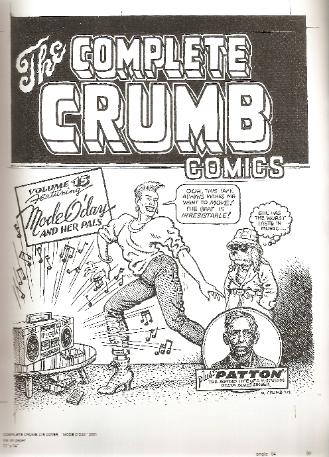
One night toward the end of 1966 I spent an hour or two with R. (Robert) Crumb, the
soon-to-be legendary cartoonist. I wasn’t yet sixteen; Crumb would have been around
twenty-three. At that time he was married to a girl named Dana Morgan, and the two of them
were poised to shake the dust of Cleveland forever from their heels. An iconic Crumb
drawing from the Keep On Truckin’ period shows him as he saw himself then, scrawny and
nerdy, levitating toward San Francisco’s Haight-Ashbury district. Exuberant proto-hippie
chicks and unfettered expression beckoned him on, an unlikely recruit to the shagadelic
armies of the Summer of Love. But at that moment in 1966 he was winding up a stint at
American Greetings, drawing user-friendly greeting cards under the direction of his boss
Tom Wilson (later of Ziggy fame). As it happened Dana’s brother was a guy I’d known since
kindergarten. For some unknown reason it occurred to him to invite me over to his brother-
in-law’s to check out his cartoons.
Robert and Dana lived in a seedy-looking apartment on Carnegie Avenue. Of course
none of us knew that some of the sketchbooks I saw that night would be traded, much later,
for a villa in the south of France, where the artist still lives with his second wife Aline
Kominsky-Crumb. If Crumb were to revisit his old University Circle haunts now he could draw
a satisfyingly ironic scene: the building was demolished sometime in the late 1970’s and the
lot is a City Side Park. Across Stokes Boulevard the venerable Tudor Arms Hotel has
become headquarters for the Cleveland Job Corps. Two blocks away the site of the 1960’s
club La Cave, where Odetta and Bob Seeger and Tom Paxton performed, has been
consumed by the ever-voracious Cleveland Clinic, as have all signs that this general area
was once a haven for beatniks like Crumb. I suppose the true-blue beats and Crumb
himself would be relieved at the absence of commemorative plaques.
Crumb’s place was sparsely furnished, orderly and clean. The artist wore his trademark
heavy-rimmed glasses, but I remember him as far more prepossessing than his self-
caricatures. Clean-shaven and painfully thin, he had a touch of draughtsman scoliosis and
a vaguely fanatical pallor – a romantic figure in his way. We sat on something Danish-
modern and drank tea. Presently Crumb brought out a pile of notebook-size comics and
sketches from an adjoining room, including his Fritz the Cat books. They weren't published
yet, so these were the hand-inked and colored originals.
Considering the standard, off-the-drugstore-shelf size of the hundreds of panels, the
detail and expressiveness of Crumb’s drawings were astounding. And as R. Crumb readers
everywhere have known for the past forty years, that was the least of it. Fritz was scruffily
cute, but as storylines progressed and the tomcat’s striped tie worked its way out of
alignment, his leers, fears, and sgtoned enthusiasms grew to be larger than life. Fritz was a
combination of cool cat and middle-class kid, often out of his depth in pursuit of such urban
desiderata as booze, drugs, and sleazeball gal-animals of various species. Elaborate
paranoid fantasies played themselves out, complete with crowd scenes and political
subplots. Racism, drug addiction, urban blight, and the cold war were among the elements
of a nightmare vision of contemporary life unlike anything I’d ever seen. These were on no
sense cartoons as I had experienced them. There were echoes of Pogo, Lil Abner, Little
Lulu, and Dick Tracy. Dr. Seuss, early Disney, maybe even the Katzenjammer Kids were
buried somewhere in the prehistory of Crumb’s dynamic, densely crosshatched depictions.
But such associations only underscored the sheer squalor of Crumb’s powerful vision.
Crumb’s demented narratives rolled along, collecting a weight of pessimism heavy enough
to crush the unwary reader.
Like any kid raised in the 1950s and 60s I was familiar with the closest precursor to
Crumb’s work. No sleepover or school locker was complete without a few tattered issues of
Harvey Kurtzman’s Mad Magazine. I learned later that Crumb had actually worked as
Kurtzman’s assistant on another zine of the period called Help! Along with the future Monty
Python celeb Terry Gilliam. Not even the scrofulous adolescent skepticism of Mad, however,
could compare with Crumb’s hot pursuit of moral decay.
Within two years his imagery was everywhere. The cartoon cover for Janis Joplin’s
Cheap Thrills album was as unavoidable as Sgt. Pepper. Crumb’s Zap Comix character Mr.
Natural was right up there with the Maharishi as one of the counterculture’s most high-
profile bogus spiritual advisors. As for Fritz, in 1970 he became the subject of Ralph Bakshi’
s trashy X-rated feature-length movies Fritz the Cat, Parts One and Two (Crumb was so
disgusted with the cat thing he eventually had Fritz murdered with an ice pick). More
recently the weirdly excellent 1995 movie Crumb, directed by Crumb family friend Terry
Swigoff, made a flash in film circles.
In the intervening decades Crumb has continued to produce a vast swamp of images,
from the first irascible issue of Harvey Pekar’s American Splendor to his own ongoing
autobiographical cartoon series titled Self Loathing; his Rapudiograph has eben in constant
motion since early childhood, when his older brother Charles bullied him into illustrating
Treasure Island for his own obsessive sexual reasons. Lately, living in the French town of
Sauve, Crumb has spent a lot of time at restaurants, usually in the company of friends; he
passes the time by sketching these people, and whatever else comes to mind, on
placemats. So far two volumes of placemat drawinsg have appeared in print under the title
Waiting for Food.
A recent exhibit at Daniel Weinberg Gallery in Los Angeles is made up largely of a
selection of these drawings, supplemented by a random group of book cover illustrations
and sketches. Whether or not Crumb has mellowed, the unedgy works at Weinberg are first
of all notable for their charm. There are studies of his wife Aline decked out in haute
couture gowns and shoes that appeared on the pages of the New York Times, poignant
depictions of his buddy Charles Bukowski, and a few earlier works still in the artist’s
possession. The placemat pieces in particular are intriguing. The quirkiness of Crumb’s off-
the-cuff preoccupations becomes tinged with melancholy, as one realizes they are so
clearly the memories and reflections of an ex-patriot. Some depict music legends like The
Notorious Genna Brothers strumming their banjos, or 1940’s cowboy singer Al Dexter. In
Crumb’s half-length version the late great Dexter holds a guitar and squints stonily, his
psychopathic sang froid shading the title of that hit number “Pistol Packin’ Mama.” Hanging
nearby, a masterful study of Fanny Brice reminds us how remarkable a portraitist Crumb
can be. A small drawing of a mildly disaffected cat, Bernie in the Morning Wanting Some
Attention, stretches its paw at us, recreating a private moment even as it inevitably recalls
Fritz – who was once Fred, Crumb’s childhood pet. On another wall I was surprised to find a
late 1960’s-era portrait of Dana Morgan, looking very much as she did the night I met her.
Everything is unmistakably, irredeemably Crumb, whose eye and hand are like a
deliberately flawed mirror. The quality of caricature has become merely an inevitable
condition of Crumb’s drawings, a stylistic burden that recalls his very public and influential
presence. But whether despite or on account of being so exaggeratedly egocentric in this
way, Crumb’s most casual drawings (like Daumier’s, or Goya’s) convey an immediate, vivid
relationship to their subjects. Crumb’s hard-won, endlessly articulated subjectivity remakes
the world as if on stage, playing to all our fabrications in the shrouded comic pages of the
brain.
[first published in Angle: a Journal of Arts + Culture, June, 2003]
*winner of Cleveland Press Club Excellence in Journalism Award, 1994