[catalogue essay for Don Harvey: Invented Landscapes / A 10 Year Survey, Cleveland Center for Contemporary
Art, 2001]
At the Edge of the Earth: The Art of Don Harvey
“Without invention nothing is well-spaced,
unless the mind change, unless
the stars are new measured, according
to their relative positions, the
line will not change, the necessity
will not matriculate: unless there is
a new mind there cannot be a new
line…”
William Carlos Williams
Inch for inch, nothing in art, or in life, conveys more than line. From computations scribbled on clay tablets to
skid marks inscribed on blacktop, from the gesture on a cave wall to the blots of Rorschach, Pollock’s drips, or
the desert trenches of 1960’s earth artist Michael Heitzer, line is infinitely various and unlimited in its capacity to
speak to the imagination. What it says, first and most loudly, is “me.” The inevitable mess we make as we step
through time and space provides the crucial dialectical lever needed to achieve identity. A mere shadow of
individual presence becomes personal as it spreads over the map our motion draws, as body and will mar and
invent the “world.”
If you travel at a leisurely pace through modern cities, as Don Harvey has walked and biked for the past thirty
years, you discover things, mostly about yourself. For an artist this translates into imagery. The grammar, the
organizing principle of an art that follows on the heels of any journey, is the hard fact of “line.” For Harvey, a
man acutely aware of the way public and private space intersect (Harvey co-founded Cleveland’s Committee for
Public Art), this kind of movement and the attention it cultivates are an indispensible part of the artistic process.
Among its myriad aspects, the grid of the city is an occasion for the kind of drawing that movement itself makes,
scribbling long repetitions in the air. As he walks, the artist is unavoidably a figure in a landscape, mapping and
pointing, reorganizing what he sees until the figure is the landscape, and the landscape is the figure. If Harvey
has found a “new line” in the course of his rambling, it is partly because clichés and preconceptions have been
bleached out, overexposed in a world of drains and debris, flattened by steel, soaked in oil-skimmed puddles,
blinded by vertical horizons. The new map of experience that emerges draws the streets and vacant lots, the life
that clings and the toxins that spread, in their own terms, saying something about the character of our era.
At the center of Don Harvey’s complex art, spanning efforts in many media over the past three decades, is a
very personal and original concept of line. In his work it is manifested as a condition of making, not discovered
but enforced and earned. This isn’t so much a line on paper or the delineation that emerges from a
juxtaposition of steel, image, and object. Nor is it the delicate fragmentation of phgotographs, taken to enw limits
of scale by jet-spray or iris print, nor even (quite) the sag and pull of viscous materials such as asphaltum and
shellac. Harvey uses all of these, in order to speak in the present tense about immediate encounters with an
urban reality. These sober, fluid or adamantine substances seem full of a sort of truth, even as they beguile
and trap the eye in a pictorial membrane. All of these techniques add up to “line” in the limited sense,
presenting imagery and generating an airy or dense overlay of detail. But the one that clounts, Harvey’s best
line, is a matter of mind and experience, bridging the distance between idea and gut feeling. It is an evocation,
or invocation, of the metaphysical condition of limits, how these are encountered and what they might mean.
“Art makes things. There are, I said, no objects in nature, only the grueling erosion of natural force, flecking,
dilapidating, grinding down, reducing all matter to fluid, the thick primal soup from which new forms bob, gasping
for life.” Camille Paglia
“A bleached and fractured world surrounds the artist. To organize this mess of corrosion into patterns, grids,
and subdivisions is an aesthetic process that has scarcely been touched.” Robert Smithson
In 1990, after a decade of reflection on the views outside his downtown windows, Harvey began to make work
that tunneled deeper into the associative space under and around the factories of Cleveland’s Flats. In the
middle 1980’s he made this environment the subject of many photographic studies and calmly aesthetic
sculptural essays, rendered in polished wood and steel. The photographs worked their way gradually onto the
metal surfaces in a variety of ways. In the 1990 Disasters of Perfect Ideas, which Harvey regards as a
breakthrough piece, four very small black and white photos are viewed through rectangular windows cut in a
four-panel grid of steel plates. These are arranged asymmetrically on a surface studded regularly with steel
screws. Three much smaller square plates project slightly from the matrix at various points, and four sealed
plastic tubes of different sizes hang from brackets (these turn out to be very important – but more below).
Soon after Disasters was completed, a way to further synthesize metal and photograph became available at
AC Color Lab on Superior Avenue, not far from Harvey’s studio. One of the services they offered was a method
of printing photographic detail on metal, a process that quickly led Harvey in new directions. At his 1990 show at
William Busta Gallery, two foot-square metal plates, distressed with caustic substances as if exposed to
industrial waste or acid rain, were juxtaposed with flaming skies, or infernal visions of chemical process. Jutting
out from these stormy panoramic grids, curiously and alarmingly, were more of those test-tube vials, offering
postmodern potions of blue and black, or murky brown and fetid green. These liquids, familiar substances like
anti-freeze, windshield wiper fluid, and motor oil, are uniquely modern products, and common pollutants. The
associations they bring with them are numerous, encouraging a variety of readings. In visual terms, for
instance, they conjure a Minimalist aesthetic in a near-satiric way; we could be looking at congealed gas from a
1960” Bruce Naumann work. Their essential significance to Harvey, however, is located at the narrow, strangely
clear space where blue and black or green and brown fail to meet. On one level, we noted that the mutual
resistance of oil and water is one of oldest and most useful facts of artistic process; an allusive realm of art
historical reference comes into play.
But probably the principal value of these captive phenomena (as with much art and most prints, the viewer
needs to approach the work closely to really appreciate the quality of the linear event) is that here Harvey’s
true, conceptual/physical edge can be discerned. This edge is a horizon, of a kind – a vanishing point where
possible and impossible regard one another. It’s about physics and chemistry, about optics and soul. Call it fate
or molecular structure, the subject of these works is ultimately a consideration of substances that may not meet
and may not mingle. Harvey told me, “The tubes are about atmosphere, in a way, but mostly about limits –
about the fact that you just can’t do certain things, and going up to that line, where gravity or chemistry or some
natural law stops you, halts your project, your desire…” So they are about desire, as well. A chasm of thought
opens at the base of this melancholy observation, an intimation of the true nature of the contours of choice,
about the mysterious inner structure of experience and identity, about the force that forever ensures a
discreteness to all that can be known.
It may be that the job requirements of an artist in the 21st century will come to include an ability to imagine
new context. The endless reinvention of line is a subtle thing that proceeds by degrees – a line that seems
freshly logical in 2001 would have been uncommunicative even to Franz Kline’s audience. Such innovation is
almost identical to the invention of context, if new worlds can only speak to us in familiar tongues. Unless there
is a new mind, there cannot be a new line. One aspect of the line that Harvey pursues is the frontier between
these, a no-man’s land between innovation and context.
Don Harvey is a large-boned, genial man, and like many artists something of a raconteur. A traveler by nature
and academic opportunity, his conversation is spiked witht ales of Reykjavik and Barcelona, Helsinki, New York,
and Philadelphia. Born in 1941, he earned his MFA at Philadelphia’s Tyler School of Art in 1971. He has
experienced first hand much of the progress of contemporary art since the late 1960’s. Among the roles he has
assumed over the past three decades are activist, professor, theoretician, sculptor, photographer, painter, and
occasional poet. In 1978, when the noted photographer John Coplans (previously editor of ArtForum) founded
Dialogue magazine, Harvey was his first editorial board member, and during 1980 it’s editor-in-chief. Harvey’s
art has been informed by the progressive political and social concerns of his generation, learning something
from Robert Smithson and Joseph Beuys, among others. He is in many ways an artist’s artist, in that his
relationship to the materials he uses is so clearly the crux of his work and its development. To the careful eye,
layer after layer of diverse influences and types of understanding are gradually unveiled. In formal terms, his
two-dimensional work, and the way the three-dimensional components of many of his wall pieces operate
visually, owe much to his background as a painter.
In a 1990 interview with artist and photographer Michael Loderstedt, Harvey cites Mondrian and Leger to
describe the uses of the grid in his work. The famous “push-pull” painterly philosophy of Hans Hoffman is always
there, also, a ghost organizing the machine. In another way, Harvey often uses unusual materials that carry
some emotional or cognitive weight. In this he resembles many surrealist sculptors, from Duchamp to Beuys and
Oldenburg. He has been called an “environmental artist,” since his work from the 1990’s makes frequent
reference to ecological issues. While he denies that he fits that profile, it’s hard to miss the genuine affinity his
work has with earlier “earth art.” Ideas developed by Smithson, Heitzer, Walter De Maria, and Dennis
Oppenheim, often seem to determine critical passages of Harvey’s method. Most items used in a list of Heizer’s
earthworks run parallel to Harvey’s, especially during the period of the current survey exhibit:
“Heizer was involved in a whole host of practices designed to break down the object, including negation (cuts,
holes, removals), duration (space as a factor of time), decay (decomposition of organic and inorganic
materials), replacement (transfer of materials from one context to another), dispersion (patterns produced by
gravity in the form of spills, slides, etc…marking (temporary random patterns on surfaces), and transfer of
energy (decomposing, sterilizing).”
Harvey’s art is less interested in such activities as the relocation of landscape, or the dislocation of gallery
space, and far less hostile to the commodity status of art objects, using photographs and physical sampling as
part of a post-painterly vocabulary. To some extent, however it is about these practices, and re-assimilates
them to the studio. His two or three-dimensional object becomes a terrain blasted by process, as unfathomable
tensions and relations flicker at the edge of the long business of art. Significance emerges as surely from a
microcosm as from a desert expanse, subject to the wind and weather of the artist’s mind. Robert Smithson
himself said, “There is no difference between the Grand Canyon and a crack in the wall.”
Some artists are born, some are made (in art school, say, or advertising). During a recent interview I asked
Don Harvey how he began to make art, not in terms of higher education, but looking back to childhood and his
earliest interests. Harvey said he couldn’t remember a time when he didn’t draw. But there were one or two
events that stood out in his mind. The story he then told seems to me to shed some light on his artistic practice.
One March or April, in the small, fairly flat town in north-central Iowa where he grew up, Don Harvey’s class
was asked to make images of Spring. Harvey was nine or ten years old. There’s no telling how many potential
artists, writers, or thinkers there may have been in the fifth grade in Gruver (pop. 130) at that time. We do know
that Harvey himself would eventually go on to consider the intimate meanings of time and change, landscape
and cityscape.
“I was gazing out the window, what I was going to draw (I knew what I wasn’t going to draw). I daydreamed for a
long time. Then I saw a tree trunk, reflected in a mud puddle. I got really enthused. That was it! It meant
something. We had been given large sheets of manila paper and big pieces of black charcoal – something that
made strong, dark marks. When I was done, my teacher put my drawing up in the classroom. Nobody knew what
it was, and she asked me to explain it, which I did. I remember thinking then that it was an important thing that I
had done, but I don’t think I put it in any context Because I didn’t have anybody to talk to about it.”
I introduce this story partly because Harvey’s work is rigorously contemporary and frankly adult as it explores
the dialectics of steel and photography in a close-reading of aesthetic and cultural transition. Despite this, there
is a freshness to his vision that becomes available to its audience only very slowly, and I suppose I was looking
for a shortcut to this more youthful soul. As I have argued above, much of Harvey’s process, perhaps all of it, is
undertaken to clear a passage for a different, intuitive style of perception, to make room for a glimpse of
meaning. Harvey approaches his ideas and imagery from several different directions, informed by a series of
artistic personae. As his work seems to curve back from a long sojourn on the fringes of technology, the
characteristic tachisme of the born painter (an interest in the random and personal mark discernable even in his
most recondite jet-spray on aluminum photo-sculptures) occasionally reasserts itself. Most recently, the human
figure enters his work. The process of choosing and editing, of rearranging experience continues, and grows
more private.
There are two statements in Harvey’s brief childhood recollection that fascinated me, both of which seem to
illuminate his life-in-art. It may be less the original “artwork” that matters in this case, but the manner of telling,
at the far end of so many years of aesthetic revision.
“I knew what I wasn’t going to draw.” What is left out of a work is as important as what is included. We know
only what the teller wants us to know, or wants to know himself. Details, such as how big, how small, how boring,
how cold are all left to the imagination. Harvey didn’t draw tulips, a picket fence, a smiling sun and an oversized
robin. This is one logical absence that jumps into clear focus. Instead, the story relates how one spring day in
childhood, he happened upon a poetics of vision. The tree trunk in the puddle image is striking enough to be a
koan evoking art in general, and Harvey’s in particular. The surprising way it seems to connect with much of the
imagery for which he is well-known is equally striking. A doubleness of vision and materials remains in the
forefront of the artist’s conceptual means. The two panels of Disasters (1989), and River and Lake (1991),
come immediately to mind. In those, the two vertically sliced halves suggest that the viewer consider them in
terms of each other – as if one reflected the other. The fact that they do not coincide, that superficially they
have little in common, becomes the subject of a spatial conversation – one that was begun long ago in a
classroom in Iowa. We may remember what T.S. Eliot has to say about April, breeding lilacs out of the dead
land, mixing memory with desire. Trunk and water, cylinder and reflective ground, rough and dry translated by
wet and deep, all of it meaning struggle, frustration, and change: this is Don Harvey’s art, a rebirth in his own
wasteland.
Then there is the secondary, complex thought that this story presents, about significance, commentary and
discussion: “She asked me to explain it, which I did. I remember then thinking that this was an important thing I
had done, but I don’t think I put it in any context because I didn’t have anybody to talk to about it.”
Ideally, no explanation should be necessary – no artist’s statements, no critical essays. The work should sink
into the eye like a stone, rippling the mind. But this is naïve. Unfortunately, the mind tends to be as paved-over
as the city. Images bounce or break against perceptual prejudice, or languish before simple indifference. This
applies to any artist, as much as any audience. Blind spots are part and parcel of the way we function. Some
vigilance is required to begin to see even what is there, let alone to see in a new way. Don Harvey’s life as
editor and educator, writer and activist has been in large part the way he has established context for his work,
beyond the immediate visual texts and pretexts of subjects, materials and influences. Explanation becomes part
of the art in many ways.
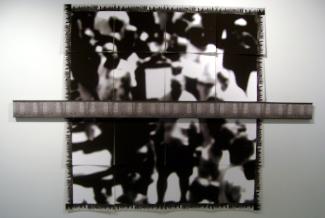
For the first time Harvey’s new work now features the human figure. This is frankly autobiographical in
intention, vividly expressing the melancholy, and the hope, of the urban wanderer. A suite of five photographic
studies on view in the present exhibit are aerial views of men in the street. Vastly enlarged and beautifully
rendered onto paper with the aid of an Iris printer, they blend Harvey’s previous concerns with a new poignancy.
The familiar compositional bifurcation is present in several of these, and the grid remains, an emblem of
painting and of the city. Unlike most of the uses to which photographs have been put in Harvey’s work over the
years, these are not edited or collaged, damaged or marked in any way. They’re digitally manipulated, and
therefore are not quite accidental, “found” urban images in the traditional, Robert Frank sense. At the same
time, their large scale tends to emphasize the graphic quality of the surface. The feeling that the subjects are
blotted, spread and sealed by light moves them far toward drawing and toward the visionary. They tug at the
unconscious, becoming emblems of the human as they elide specific detail and substitute a palette of tonal
shifts. These are walkers, as Harvey is a walker, in the company of light and shadow. Shadow Rider shows a
figure who appears to contemplate or confront an enormous, ink-blot-like shade cast from an umbrella; both are
inscribed on a slanting grid of shadow, projected from the windows of a nearby building. Walker No. 2 is
vertically divided into a day and night of bleached brightness and complex grays. In the daylight half a man’s
shadow puddles down and across, communicating between the sharply divided visual fields. Walker No. 4
reverses these areas and intensifies the darkness, which pushes against the shoulder of a foreshortened figure.
Something grand haunts Don Harvey’s work. Throughout its considerable breadth, ways in which the
acquiring, suffering mind encounters the capabilities and incapacity of the body are transcribed. Nature and
industry, surface and substance act out the fundamental conflicts of the soul. These are hard and central
subjects, which few dare to address directly. A less determined spirit than Harvey’s might long ago have
succumbed to grandiosity, sentimentality, or silence. His imagery retains a simplicity and severity that serves the
artist’s journey well: the burdens of Harvey’s lighten as he treads farther over the volcanic crust of our time. The
figure seen in Walker No. 2 is more insouciant than the others, as he strides away from the camera upward into
the picture plane. His hands are in his pockets and his shadow seems to diminish; next to him, larger than his
own outline, shimmers a human-shaped patch of light, like a promise.