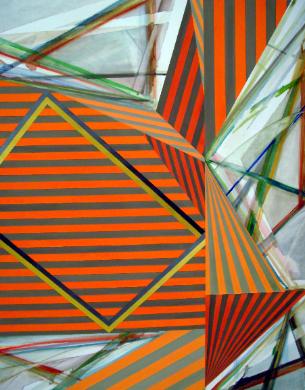
No Way Out Gianna Commito’s paintings catch the eye at William Busta A painting isn’t just a thing, or only descriptive of other things. It’s also a place, plus a way of getting there, driving by or parking at the scene of a series of visual events. Gianna Commito’s stubborn paintings are about all that, and about balking, stalling, starting and stopping on the road leading from the brain to the limit of the eye. Puzzles and all kinds of games trap and bend our sense of time. Commito’s particular activity is akin to pick-up sticks, played with painted lines. She dumps these strategically on a sensuous hardboard surface that gives a satisfying sort of “thock” to her mixed paint media, like a ball bouncing on a clay court. The viewer then tries to make some sort of sense out of them, but as Luis Camnitzer, a curator at The Drawing Center in New York, comments about her work, “I realized that the work did not have a real compositional order nor, for that matter, any order…Conditions that seemed to lead to balance and harmony eventually ended in self-destruction.” Though Commito’s fifteen paintings in the show “Windows and Doors” at William Busta Gallery may look like formalist exercises at first glance, they’re not. They’ve journeyed far into the illogic of a post postmodern mindscape, and are just plain radically cool. Rendering piles of things in a rainbow of colors isn’t unusual in contemporary art. Among painters exhibiting at William Busta, Tim Callahan and Matt Kolodziej have both come up with innovative ways of using heaped-up boards and generic construction rubble as an element in works that examine the alternately discrete and stuck-together structure of everything. From the semi-urban mess typical of early twenty-first century America to the chemical and electrical docking mechanisms of the brain, physical reality demands adaptability, which is perhaps one subject of such works. A sense of humor is another element, and while none of these artists could be said to do stand-up, a tickle is built into their disheveled images. With Commito, who is an assistant professor at Kent State University, this is mostly a matter of broken or interrupted connections. Her piles aren’t made up of things that just block each other in ordinary ways. They connect in ways that don’t make sense, disintegrating into nonsense just as they begin to look like familiar surfaces. “Wing,” for instance, rendered in contrasting areas of sharp- edged, vibrant casein and soft, brushy watercolor, is a weird contraption of a painting, part Op-art and part broken M.C. Escher. There is no way for the eye to enter into the work – although it seems as if there should be. A tri-color band like a warped frame is jammed around vertiginous areas of lemon yellow planes and gray stripes, or vice versa; optically farther back a network of broad crisscrossing strokes webs much of the remaining space. There’s no way in, but also no way out, which with these disconcerting, clever paintings is actually a good thing. |
Gianna Committo, 2010